Sudoku Master!
- 4.8
- Rating
- 10.00M
- Installs
- Free
- Price
 Analysis by App-foxy
When I want a Sudoku session that does not depend on a connection, I keep coming back to Sudoku Master. Its defining strength is straightforward: it puts a very large collection of puzzles on the phone and separates them into six difficulty levels. That sounds simple, but it changes how useful the game feels during ordinary gaps in the day. I can open it on a journey, during a waiting room visit, or at home when I want something quiet, without first looking for a puzzle online.
This is a free puzzle game from HungryStudio, aimed at Everyone and available for Android devices running version 6.0 or later. It has reached over 10 million installs and holds a 4.8 average from around 258 thousand ratings, which gives a good indication that its uncomplicated approach works for a broad audience. I tested it as a casual player rather than treating it like a competitive brain-training tool, and that distinction matters: the appeal is the steady solving routine, not a dramatic presentation or a story-driven experience.
Why the offline puzzle library matters
The offline focus is the feature that deserves the most attention. Many Sudoku games are easy to start but less convenient when the internet is unreliable, mobile data is limited, or you simply want to put your phone in airplane mode. Here, the promise of more than 40,000 puzzles makes the app feel less like a one-time download and more like a pocket puzzle book that can keep supplying sessions for a long time.
You May Also Like

 Blood Strike: 2.5 Anniversary
Blood Strike’s Loadouts Turn Every Drop Into a Tactical Gamble
A close look at Blood Strike’s custom loadouts: how fast access to signature weapons reshapes its battle royale rhythm, rewards preparation, and narrows the gap between fights.

 Pandora - Music & Podcasts
Pandora’s Music Is Easy to Start, but Harder to Recover
Pandora’s strength is its low-effort path from a seed to a station. Its weak spot is how much confidence it asks you to place in connection, setup, and quiet recovery.

 8 Ball Pool
 Is Built on Rivalries, Rematches, and Routine
A close look at the rivalries, rematches, shared routines, and unanswered safety questions that turn a quick pool match into a persistent mobile community.

 Samsung Music
’s Quiet Strength Is Playing What You Already Own
Its reach comes less from spectacle than from dependable access to a personal library. That simplicity is both the app’s strongest retention engine and its ceiling.

 AccuWeather: Weather Radar
AccuWeather Review: A Quick, Clear Forecast for Everyday Decisions
For everyday plans, the best forecast is the one you can understand quickly. AccuWeather makes rain timing, radar, and local conditions easy to act on, with a few trade-offs.

 Hill Climb Racing
Why Hill Climb Racing Still Turns Crashes Into One More Run
A tiny car, a bumpy hill and one more upgrade: Hill Climb Racing keeps resurfacing because its simple chaos makes every near-miss feel personal.
More From Our News Desk



For me, the practical benefit is consistency. I do not have to choose a website, close advertising-heavy pages, or wait for a new board to load. I can begin with a difficulty that matches my concentration and stop whenever I reach my destination. That makes this a particularly comfortable choice for short, interrupted sessions, where setting up a game should take seconds rather than become part of the task.
The six difficulty levels also give the offline collection a useful shape. A beginner can stay with gentler boards while learning the basic rhythm of scanning rows, columns, and boxes. Someone more experienced can move upward when the easier puzzles stop demanding enough attention. I like this more than a single endless stream of puzzles because it lets me decide whether I am looking for relaxation or a more demanding mental workout.
There is an important trade-off here. A large library does not automatically mean every puzzle will feel fresh or perfectly matched to your ability. If you already solve advanced Sudoku every day, the lower levels may feel disposable, and even the harder settings may not replace a specialist app built around deep solving tools. The collection is most valuable because it is convenient and plentiful, not because it turns Sudoku into a tournament platform.
Starting at the right level
My advice is to resist the temptation to choose the hardest option immediately. Sudoku difficulty is not only about how long a board takes; it also affects whether the solving process feels logical or turns into repeated guessing. I would begin one level below what I think I can handle, then move up after completing several boards without leaning heavily on assistance. That creates a better personal baseline than judging the game from one unusually easy or frustrating puzzle.
This approach is also useful for returning players. If I have not played for months, an easier board helps restore the visual habits that Sudoku requires. I start noticing missing numbers and restricted positions again instead of spending the whole session trying to remember a method. Once that comes back, the next difficulty feels like a natural step rather than an unnecessary wall.
The app works well as a low-pressure introduction because the basic objective remains visible from the first board. There is no need to learn a fictional world, manage a character, or understand a complicated menu of modes. The game puts the number grid at the center, which is exactly what I want when I have only a few minutes and do not want extra decisions.
How a typical session feels
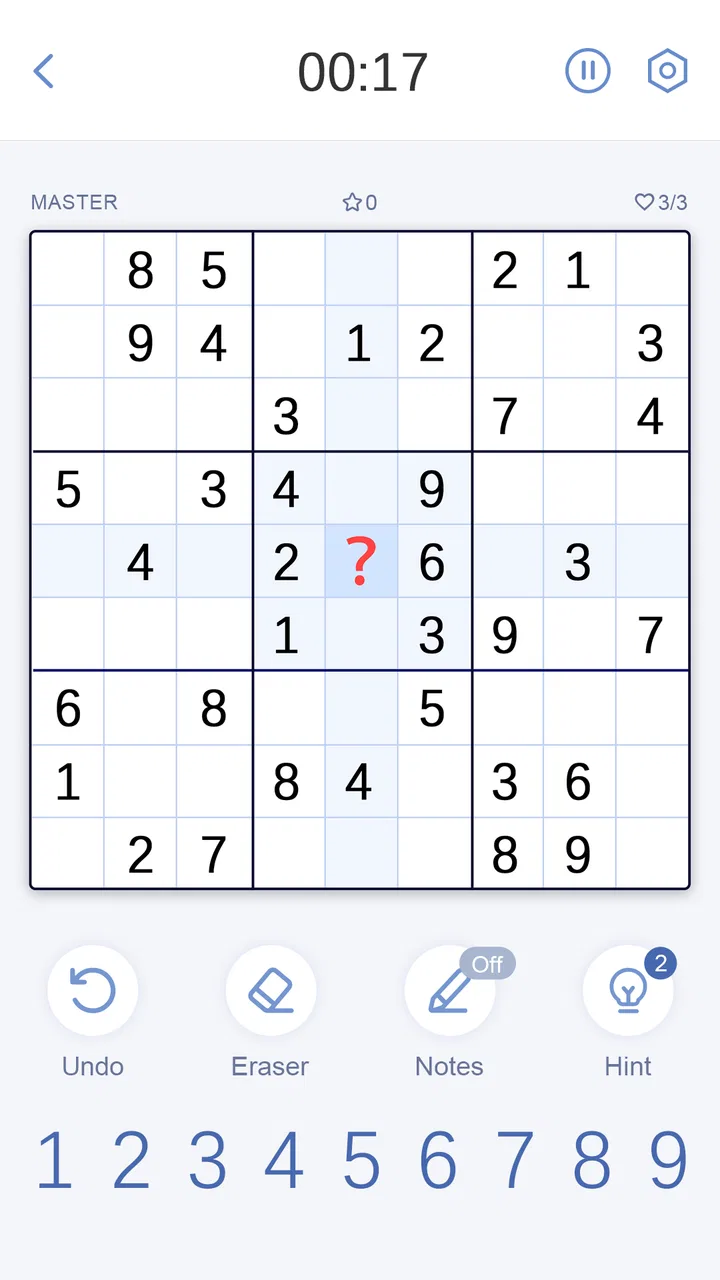
A normal session begins with a choice of difficulty, followed by the familiar nine-by-nine grid. I usually spend the first minute looking for obvious placements rather than entering numbers quickly. That small pause is valuable because it turns the game into a process of observation. I check each row, column, and three-by-three box, then build outward from the numbers that have the fewest possible positions.
The best way to use a puzzle like this is to treat every entry as a deduction, not a guess. When a number can occupy only one square in a box, I enter it and scan again. A newly completed row can reveal a position elsewhere, and that chain is where the satisfaction comes from. On easier levels, the progress is immediate. On tougher ones, I need to keep a more careful mental list of candidates and avoid filling a square simply because it looks plausible.
I find the offline format especially helpful for this style of play because it removes the pressure to finish in one sitting. If I am interrupted, I can put the phone away and return later. That is a better fit for Sudoku than a game that expects constant attention or punishes a pause. A board can become a small ongoing task across a commute, a lunch break, and an evening wind-down.
One realistic example is a long train ride with inconsistent reception. I can select a moderate puzzle before leaving, solve the obvious sections while seated, and pause when the carriage becomes busy. Later, I return to the same grid instead of starting over or searching for another page. The result is not exciting in the traditional gaming sense, but it is exactly the kind of dependable distraction I want in that situation.
A practical routine for harder boards
For more difficult puzzles, I recommend dividing the session into passes. First, fill only the numbers that are completely clear. Second, inspect each box for numbers that have one possible location. Third, revisit the rows and columns affected by those entries. This prevents the common mistake of staring at the entire board without a plan.
I also find it useful to stop when I begin making careless entries. Sudoku is supposed to reward attention, and a tired player can turn a solvable board into a confusing one by introducing a single unsupported number. Because the game is free to open whenever I want, there is no reason to force a finish. Leaving a puzzle for ten minutes often makes the next scan much clearer.
This is one of the less obvious strengths of a large offline collection: it supports a personal rhythm. I can use an easy board as a warm-up, a medium board for a short break, or a harder one when I want sustained concentration. I do not need to reserve a long uninterrupted block of time, and I can choose according to my energy rather than according to whatever puzzle happens to be available online.
The best setting for this game
Sudoku Master is at its best for people who want a calm, repeatable activity with very little setup. It suits commuters, students taking a quiet break, older players who prefer familiar number puzzles, and anyone trying to reduce the amount of passive scrolling in their day. The Everyone content rating also makes its tone approachable for a wide audience, although younger players may still need help understanding Sudoku logic rather than simply tapping numbers at random.
I would particularly recommend it to someone who has tried Sudoku in newspapers or on websites and wants a more convenient phone version. The six levels make it easier to find a comfortable starting point, while the offline library means the game can travel anywhere. It is also a sensible companion for travel because the core activity does not rely on a live connection.
Another good use is as a transition between tasks. I sometimes play one short board after finishing work, not because I need to win, but because the focused scanning helps me stop thinking about unfinished tasks. The game gives my attention one clear problem to solve. That benefit depends on playing deliberately; if I rush through entries while distracted, it becomes less relaxing and more irritating.
It is less suitable for players who want a social layer, competitive rankings, elaborate visual rewards, or a story. This is a number-grid puzzle first. People who enjoy daily challenges with public scores may prefer a more competitive alternative, while players who need detailed tutorials may want an app that teaches advanced solving techniques step by step. Likewise, if I want a broad collection of different puzzle types, this focused Sudoku format will feel narrow.
How it compares with common alternatives
Compared with solving Sudoku in a newspaper, this game is more portable and easier to adjust to my ability. I do not need a pen, and I can move between difficulty levels instead of being limited to the puzzles printed on one page. The paper alternative still has a tactile charm, though, and some people will prefer writing candidates by hand to tapping on a screen.
Compared with browser-based Sudoku, the main advantage is the offline experience. A website can offer variety and quick access, but it may also bring distractions from other tabs or require a connection at the moment I want to play. This app feels more self-contained. On the other hand, a browser can be better when I use several devices and do not want to install another game.
Compared with feature-heavy Sudoku apps, the appeal here is restraint. A specialist alternative may provide advanced notation, extensive statistics, timed competitions, or detailed hints. Those tools can help serious solvers study technique, but they can also make a simple break feel like a performance test. I would choose this game when I value a large supply of accessible boards over a large supply of analysis screens.
Where the experience has limits
The free entry point is welcome, but the presence of in-app purchases ranging from $0.99 to $39.99 per item means some players may encounter optional spending prompts. I do not see that as a reason to dismiss the game, but I would approach it with a clear rule: enjoy the free puzzle experience first and avoid buying anything unless it solves a problem I genuinely have. A Sudoku app should not pressure me into spending just to continue a basic session.
The game’s simplicity can also feel plain. If I am looking for a polished audiovisual presentation, a strong sense of progression, or a reason to return beyond the next grid, this may not hold my attention. The same minimalism that makes it easy to start can make it feel repetitive after several boards in one sitting. I get more from it when I play one or two puzzles and stop, rather than trying to consume the library like a campaign.
Difficulty selection is useful, but it does not remove the need for self-management. A puzzle marked at a comfortable level can still expose a weakness in my solving habits, especially if I rely on intuition instead of checking candidates. I would not judge the whole game by a single board that feels unusually stubborn. Sudoku naturally varies in how quickly its logic opens up, and patience remains part of the experience.
There is also a difference between having many puzzles and having a learning system. If my goal is to become substantially better at advanced Sudoku, I would want explanations of techniques such as pairs, triples, or more complex candidate interactions. This app is better viewed as a practice space than as a full course. I can improve through repetition, but the game itself is not a substitute for studying a method when I become stuck.
Small habits that improve the value
I get better sessions by choosing the difficulty based on my available time. For a five-minute break, I select an easier board and focus on clean deductions. For a longer evening session, I choose a level that may require several rounds of scanning. This avoids the frustration of beginning a demanding puzzle just before I need to leave.
I also avoid treating completion speed as the only measure of success. A slower board solved without guesses teaches me more about where I overlook possibilities. If I make a mistake, I retrace the last few entries instead of immediately abandoning the puzzle. That habit turns an error into a review of my reasoning, which is more useful than simply chasing another board.
Finally, I use the offline collection as a reason to prepare before a trip. I open the game while I still have a connection, choose a suitable level, and make sure I have a puzzle ready. The whole point is convenience away from the network, so a little preparation makes the feature work at its best.
Who should download it
I think this game is a strong match for a player who wants free, familiar Sudoku with a substantial supply of offline puzzles and a clear choice of challenge. It is especially good for casual practice, travel, short breaks, and quiet routines. The 4.1.1 version keeps the experience current for people using supported devices, while the low minimum system requirement makes it accessible to owners of older Android phones.
I would skip it if my main reason for playing is competition, deep performance tracking, social interaction, or guided mastery of advanced techniques. A different Sudoku app may be better for those goals. I would also skip it if I know I need constant novelty from several puzzle genres; this game stays firmly focused on Sudoku.
For everyone else, the decision is fairly easy because the core cost is low: the game is free to download, and the basic idea is immediately understandable. The important question is not whether it has enough decoration, but whether I want a dependable offline puzzle collection. If the answer is yes, the combination of six difficulty levels and a very large library makes it practical rather than merely convenient.
After using it, my recommendation is positive but specific. I would suggest it to a friend who wants a Sudoku board available without reception, without a newspaper, and without a complicated learning curve. I would describe it as a reliable pocket puzzle book, not as a full competitive platform. Its real strength is the freedom to choose a suitable challenge and return to it anywhere, and that is enough to make it worthwhile for the right kind of player.
HungryStudio has kept the focus where it belongs: on solving grids. The result will not satisfy every enthusiast, but it does not need to. For a calm, portable puzzle routine that works offline and offers room to move from beginner-friendly boards toward more demanding ones, Sudoku Master earns a place on my phone.
FAQs for Sudoku Master!
01What features does Sudoku Master! offer that enhance the gameplay experience?
Sudoku Master! offers a variety of features designed to enhance the user experience. These include multiple difficulty levels, an intuitive interface, hints for tricky puzzles, and an auto-check function to prevent errors. Additionally, players can track their progress and compete in daily challenges, making it perfect for both beginners and seasoned players.
02Is Sudoku Master! free to download and play?
Yes, Sudoku Master! is free to download and play, although it may offer in-app purchases. These purchases can include additional hints, removing ads, or unlocking special themes. The free version provides a comprehensive experience, but purchases can enhance gameplay by offering more customization and convenience.
03How does Sudoku Master! handle user data and privacy?
Sudoku Master! takes user privacy seriously. The app may collect basic data to improve user experience and game performance, but it ensures compliance with data protection regulations. Users can review the privacy policy within the app to understand what data is collected and how it is used, ensuring transparency.
04Can I play Sudoku Master! offline, or do I need an internet connection?
Sudoku Master! can be played offline, making it perfect for on-the-go entertainment without the need for an internet connection. However, some features, such as daily challenges and leaderboards, may require a connection to function properly. This ensures users have access to all game modes and features.
05Are there any accessibility options available for Sudoku Master!?
Sudoku Master! includes several accessibility options to accommodate diverse player needs. These may include adjustable font sizes, color contrast settings, and voice guidance. Such features aim to provide an inclusive gaming experience, ensuring that players with different abilities can enjoy the puzzles comfortably.
Pros
- Intuitive interface for easy navigation.
- Variety of difficulty levels.
- Offline play available.
- Customizable themes and designs.
- Daily challenges for skill improvement.
Cons
- Ads can be intrusive at times.
- Limited hints in free version.
- No multiplayer mode available.
- Occasional app freezing issues.
- Requires frequent updates.

Sudoku Master!
Gallery